




Timing diagrams are the main key in understanding digital systems. Timing diagrams explain digital circuitry functioning during time flow. Timing diagrams help to understand how digital circuits or sub-circuits should work or fit into a larger circuit system. So learning how to read Timing diagrams may increase your work with digital systems and integrate them.
Bellow is a list o most commonly used timing diagram fragments:
- Low level to supply voltage:

- Transition to low or high level:

- Bus signals – parallel signals transitioning from one level to other:

- High Impedance state:

- Bus signal with floating impedance:

- Conditional change of on signal depending on another signal transition:

- Transition on a signal causes state changes in a BUS:

- More than one transition causes changes in a BUS:

- Sequential transition – one signal transition causes another signal transition, and the second signal transition causes the third signal transition.

As you see, timing diagrams together with digital circuits can completely describe the circuits working. To understand the timing diagrams, you should follow all symbols and transitions in timing diagrams.
You can find plenty of symbols in timing diagrams. It depends actually on the designer or circuit manufacturer. But once you understand the whole picture, you can easily read any timing diagram like in this example:
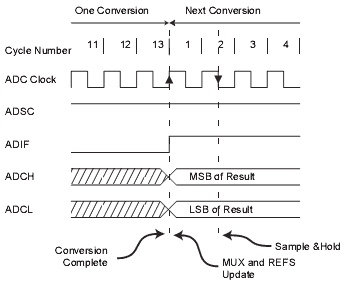
Sometimes you don’t even need to read the documentation to understand how one or another circuit works. You look at the Timing diagram, and it’s all clear.
Fantastic article….kudos
Nice article and very simple to understand..!
nice one… it took me two minutes to read and understand your article hehehe
Perfect article thanx!!!
The board uses ISP programming method through parallel port adapter. It has all I/O connectors, single sided PCB. It has on board voltage regulator 7805.
Is there a (good) tutorial on how to use this info to write a computer program for the device?