




When the developer selects a transducer for their projects, they have to look through various parameters and then select the part that best fits the design needs. This time let’s look at some transducer characteristics that can be found in specifications.
Transducer Range
First of all, let’s clear out what is a range of a transducer. The range is understood as maximum and minimum input and output signal. For instance, we can take a simple thermal sensor which input range can be from -50 to 120ºC and output range of 0 to 5V. The range can be understood as measured signal range and working environment parameters like working temperature range, power supply voltage range, etc.
Full-scale deflection – Span
Span is the maximum variation in the input or output. Span can variate due to an error that is mostly linear and can be adjusted. Span error is measured in percents, which shows how much the output value is different from the correct value.
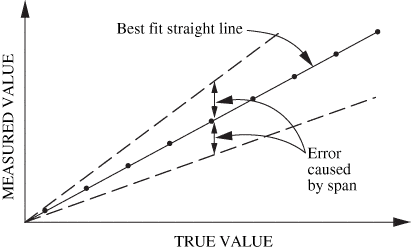
Another linear error close to span error is zero offset. This error occurs because of calibration errors or other changes like aging or environmental conditions change. Zero offset error is a constant overall range. It can be fixed by recalibration of the transducer.
Nonlinearity
Nonlinearity describes the deviation of a linear relationship between input and output.
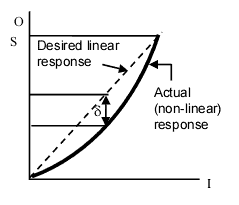
If nonlinearity is known, then the true linear output may be obtained using a look-up table or by altering the output signal electronically.