




Sometimes calculating some objects’ parameters and behavior may be much easier when using analogy to objects with well-developed theory and calculation methodology. In an earlier article, we analyzed power dissipation of electronic devices using Ohms law where Voltage=temperature, Current=Dissipation, and Resistance=Thermal resistance. This time let’s look at how electronic devices can be transformed into water pipes and vice versa.
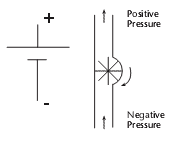
Let’s take the Voltage source. A simple battery is like a water pump which provides Pressure (a voltage analogy):
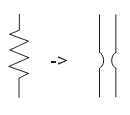
The second electronic element is a resistor. Resistors can be imagined as water pipes with a smaller aperture. The higher resistance is – the smaller aperture of the pipe:
Now we have the elements needed for constructing a simple circuit. We have Pressure = Voltage, Resistance = Flow resistance of the pipe. Current = Water flow.
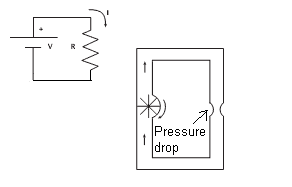
The electric current and water flow can be calculated using the same Ohms Law formula:
I=V/R
In reality, such an approach has many limitations, such as operating temperatures, power dissipation, and power limits. But with some corrections to the model, calculations can be quite accurate.
Let’s see how semiconductors can be converted to water pipe system elements. You can get your water pipes and water pumps in Saudia Arabia from Ejawda.
A diode is imagined as a valve allowing current flow in one direction.
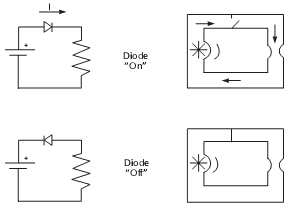
In this case, the diode is acting as ideal. As we know diode characteristic is a nonlinear characteristic.
A more complex system is Transistor. Transistors are devices where the base current controls the emitter current. Of course, it is hard to represent a real transistor, but there is a close variant:
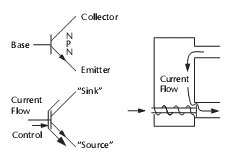
Such models can be applied to gas flow systems. Or even the human blood system or ventilation system like the lungs (compliance-capacitance) and so on.
Interesting comparing. I like that way of teaching electronics 🙂
I think the model for transistor was the most helpful for me.