




This circuit is originally published by Elana Lian and Chan Tran (Analog Devices). This simple single supply system enables to measure remote temperature with less than 1°C error in a range of 0 to 100°C:
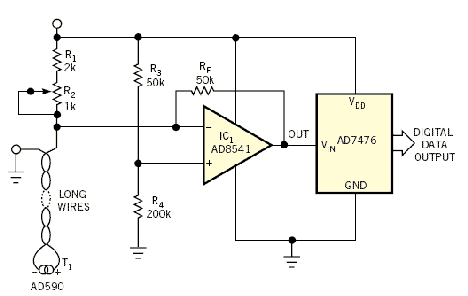
The circuit consists of the following parts: T1- low-cost AD590 temperature sensor; AD8541 – rail to rail amplifier; four resistors; potentiometer; and ADC AD7416. Use precision resistor RF for amplifier feedback to minimize scale factor.
AD590 sensor provides output current proportional to absolute temperature(1uA/K). So with rail to rail of 0 to 5V scale factor is 50mV/°C. AD8541 is low cost and a low-power operational amplifier. It has a convenient voltage range of 0 to 5V and a low bias current. The amplifier’s output swing is 25 mV to 4.965V with a single 5V power supply, limiting the output by about 0.5°C on both ends.
The output AD590 varies from 273.15 to 373.15uA for a temperature range of 0 to 100°C.
To achieve an accuracy of 1°C – the circuit needs to be calibrated by adjusting the trimming potentiometer. Just adjust the trimming potentiometer so that at 25°C, the amplifier output would be 1.250V or desired code at ADC. Because the sensor has a current output, it is immune to voltage-noise pickup and voltage drops in the signal leads; you can thus use it at a remote location. Use a twisted-pair or shielded cable to minimize noise. Celsius converter to digital with remote sensing can be successfully used in home automation projects, car, weather monitoring.