




A decibel is a special unit that is a little different from other measuring units in everyday practices. This is a nonphysical unit but more mathematical understanding. Decibel (dB) units are similar to percent (%), just different calculations and purposes. As a percent unit, so decibels are used to compare two quantities as the whole value in percents is expressed as 100%, so decibels are more complex, and it is a ratio of two independent quantities. Decibels are mostly used for energetic parameters like power or voltage and current.
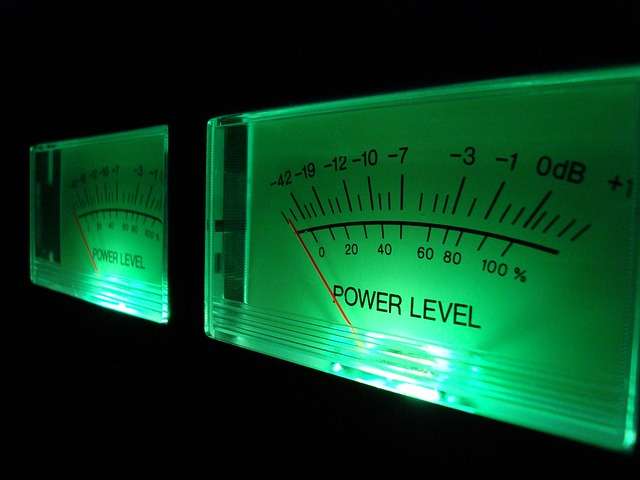
Decibel (dB), equal to 0.1 bel (B) . Bel – is a decimal logarithm of the ratio of two powers. If these powers P1 and P2, then the expression looks like this:
NP=lg(P2/P1) [B]
In physical nature, any power can be compared: electrical, acoustic, mechanical. The important part is that both variables were expressed in the same units – watts, milli-watts, horsepowers (HP).
Practically speaking, Bel (B) is a way too big a unit. Even big ratios of power give a small B. For instance, P2/P1=100, lg100=2. If P2/P1=1000, lg100=3. So the big difference 100 and 1000 in bels will be 2B and 3B. For more detailed and convenient use bels are converted in decibels like 2B->20dB:
DP=10lg(P2/P1)
As bels and decibels are a ratio of two values, the operations using bels or decibels are the same as with logarithms.
Positive decibels usually mean signal magnitude(in amplifiers), while negative decibels mean energy loss (in filters, voltage dividers). A good point of decibels is that they are widely used and because of universality. It is easy to represent values from 1 to millions in a convenient form (graphically).
But there are some disadvantages. Calculating decibels requires reference tables of logarithms and decibels. Another disadvantage is that there is no absolute reference point for decibels as there are no 0 watts in decibels.
For instance, if we measure sound level, the reference point is taken air pressure as 20 micro pascals, or 0.02 mPa – close to the limit of sensitivity of the human ear. Then if wee hear 20 log (p2/p1) = 86 dB sound it means log (p2/p1) = 4.3 and p2/p1 = 104.3 is about p2/p1 = 20,000. This is a loud but not dangerous level of sound if it is not maintained for very long.
Important part is that if measured quantity is equal to reference level, then we get 0dB: 10log 1 = 0dB.
Few most common values in following table:
INCREASE IN POWER LEVELS (WATTS)
dB=10*log(P1/P2)
DeciBels   Output Signal Strength
3dB           2x
6dB           4x
10dB (1 Bel)  10x
20dB         100x
30dB       1,000x
40db      10,000x
ATTENUATION OF AMPLITUDE (VOLTS or AMPS)
dB=20*log(A1/A2)
DeciBels   Output Signal Strength
-3dB        0.707x
-6dB        0.5x
-10dB        0.316x
-20dB        0.1x
-30dB        0.032x
-40db        0.010x