




Reliable soldering can be achieved by soldering clean surfaces. Usually, surfaces are cleaned with abrasives and solvents, but after the surface is cleaned surface immediately oxides, especially when heated. During oxidation, the surface is covered by thin oxide film, which prevents solder from contacting metal. This is why flux is used in the soldering process. To remove/deoxidize, surface flux must be applied during soldering. Flux chemically removes surface oxide when heated and makes a good metal to solder contact.
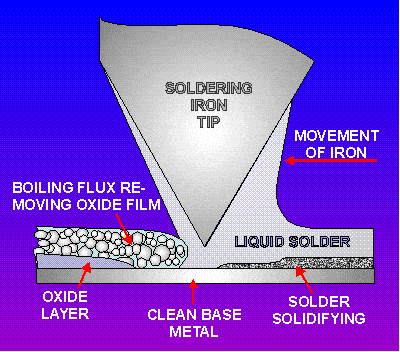
There are several categories of soldering fluxes:
- Acid Flux (or commonly known fluxes: Zinc chloride, hydrochloric, ammoniac);
- Organic Flux;
- Rosin Flux.
Each flux has its own specifics and may be used for different soldering technologies.
Acid Flux
Acid Flux is the most active of the group. It is effective on almost all metals, excluding aluminum and magnesium. But Acid(chloride) flux has several significant disadvantages: it is highly corrosive, electrically conductive, and is difficult to remove from the soldered joint.

It would help if you never used acid fluxes in electronic device soldering and repair, as it will cause corrosion and even can short-circuit device where gaps between tracks are small.
Organic Flux
Organic flux has almost the same effect as acid flux but is less corrosive, isn’t conducive to electric current, and is easier to remove from soldered joints. But again, it has a corrosive effect if not cleaned well.
Organic fluxes also are biodegradable if stored for a longer time. So this flux also not acceptable for microelectronics.
Rosin Flux
Rosin flux is ideally suited for microelectronics as it has a special molecular structure. It is usually pure rosin dissolved in a suitable solvent. Rosin flux works well with almost all electronic contacts. Flux becomes very effective at soldering temperatures. It is non-corrosive, non-conductive.

Rosin flux is usually included in the solder wire core. So when soldered with such solder, when the heated flux is applied to the joint and flux flows on the surface and removes oxide. Rosin fluxes may be a different type of activity:
- R– Rosin only;
- RMA – Rosin Mildly Activated;
- RA– Rosin Activated.
Depending on surface cleanness, it depends on what activity Rosin uses. If the surface is immaculate, use R rosin; for less clean surfaces, use RMA or RA rosin flux, but they have additional ingredients like organic acids and other acids. So they leave inert residues after soldering.
Despite what flux is used, it is always recommended to clean joints with flux remover to avoid corrosion, contamination, and PCB looks much more professional when cleaned.
I’m trying to find the actual chemicals used as flux for aluminum to aluminum soldering using aluminum fill rods for bonding to a boat hull. I know that borax is used for brass rod but don’t know what works for my aluminum boat. I’m trying to build a steering console and dashboard and weld it between the center seat and the front seat.