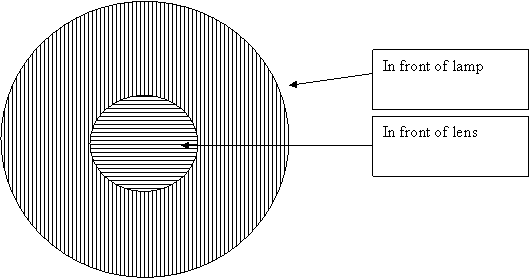
I used a simple lamp directed to the glossy table surface. One polarizer is in front of the lamp, and the other is in front of a digital camera lens. Both polarizes perpendicularly oriented to each other. How does this work? A theory about an angle on which the incident polarized electromagnetic waves turn reflects from the surface with a polarization plane turned in 90 degrees.
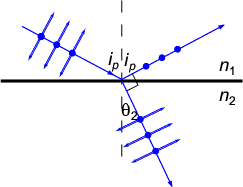
When light going through the polarizer towards the surface, the light is polarized in one direction, and when it reflects from the surface, it is turned by 90 degrees. Another perpendicular polarizer filters those waves in front of the lens.
As you can see bellow in images there is no mirror reflections left.
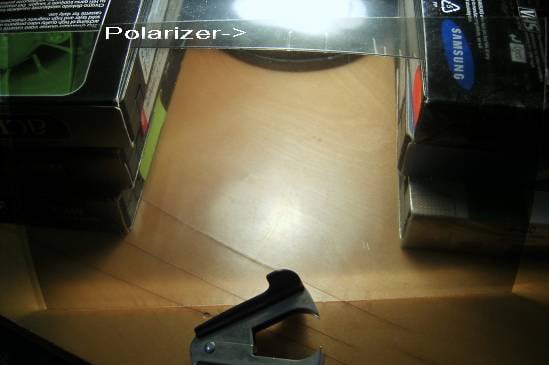
When both polarization planes are parallel – then we see reflections

When both polarization planes are perpendicularly – then reflections are gone.
Here is a system of positioning of polarizer films explained: