




Oscilloscope Probes
Measuring signals with oscilloscopes may be a challenging task especially high-frequency ones. Without proper oscilloscope probes, correct measurement of high-speed time-domain signals wouldn’t be possible. For high-speed measurement, you should consider signal parameters like amplitude, source impedance, rise time and bandwidth.
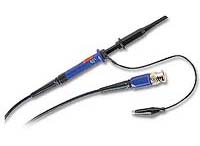
There is a wide variety of probes available – passive, active, current-measurement, optical, high voltage, and differential. But let’s narrow the discussion to probes used to measure signals with wide bandwidth and short rise times. There are also many variations on what probe is proper. As probes are potential load to measured circuits, it is important to know their sensitivity to resistive, capacitive, or inductive loading. Incorrectly chosen probes (like high capacitance) can distort the fast-rising signal. Some circuits may not tolerate probes at all (high-speed amplifiers).
So first of all, use two signal parameters for selecting probe bandwidth and rise time. Generally speaking – scope and probe bandwidth should be three to five times wider than the measured signal. Select a probe that is at least the same frequency range as the oscilloscope being used. When using a 100MHz oscilloscope, select a minimum of 100 MHz probes. To achieve the optimum performance, choose a probe with more than twice the bandwidth of the oscilloscope.
Probe Bandwidth
It doesn’t matter what type of signal is measured it is always important that scope has enough bandwidth to reproduce the signal correctly. For analogue signals, the highest frequency will determine the scope bandwidth while in digital signal measurements there is signal rise time important. Like usually bandwidth is determined at -3dB level or 70.7% signal drop level:

To avoid significant measurement errors, measurements should never be performed near -3dB bandwidth level. Otherwise, it may produce up to 30%amplitude error for the sine wave. So if 100MHz signal is measured with a scope where bandwidth is 100MHz, then the signal will have about 30% error. So with a 100MHz oscilloscope, the measured signal frequency shouldn’t exceed 0.3·100MHz=33.3MHz. For a 100MHz signal, there is a 300MHz bandwidth oscilloscope needed. Probe bandwidth should be at least twice as an oscilloscope. This would be 600MHz. Then you should achieve less than 3% error.
For digital signals, the rise time is important. Rise time determines probe bandwidth. Let’s say we use a simple RC network probe:
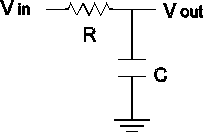
Input signal is voltage step, and then output voltage will be calculated as follows:

Rise time is a time that is taken by the signal to go from 10% (0.1RC) to 90%(2.3RC) of its level. So the difference is equal to 2.2RC. -3dB bandwidth is equal to 1/(2πRC). Then

And bandwidth is

According to the formula, if the signal rise time is 2ns, then probe bandwidth would be PdF=0.35/2ns=175MHz. And to ensure less than 3% error, we should use three times bigger probe bandwidth, about 600 MHz.
Inside the oscilloscope probe
Probes are simple devices but may have a significant impact on the measured signal. Usually, the probe consists of:
- Probe tip
- Parallel RC network
- Shielded wire
- A compensation RC network
- Ground clip

The main requirement for probes is that they didn’t provide any invasive effect on the measured circuit. One of the factors is high impedance to meet this requirement so that it wouldn’t load the circuit. The most popular probes are 1X and 10X probes. For instance, a 10X probe attenuates the signal by factor 10. it has 10Mohm input impedance and 10pF tip capacitance, while 1X probes have 1MΩ input impedance and 100pF tip capacitance. For accurate measurements, probe tip resistance Rp and capacitance Cp must be equal to oscilloscope input resistance RIN and capacitance CIN. To ensure they are equal, the scope has to be calibrated.
Probe calibration
Calibrating a probe isn’t a hard task, especially when the oscilloscope has the necessary tools built-in. This is a signal generator used for calibration. Please turn on the signal generator on the oscilloscope and put the tip to it, and ground clip to oscilloscope ground. There should be some sort screw for adjustments in the compensation box of the probe. By inspecting signals from an oscilloscope, you can compensate the probe.

Overcompensated or under-compensated probes may produce significant errors in rising time and amplitude.
Source: ADI
Hi There!
What I’ve want to know is;
1. Current measurent with high accuracy up to let’s say 100MHz with moderate accuracy was possible when attached to the input of DSO?
2. Is there current probe provides a truly displayed a real current waveform so if I use multi trace oscilloscope use for voltage measurement simultaneously? So I expect in this way I could observe current and voltage waveform relationship at the same time when observing a complex electrical waveform?
3. If point 2 above satisfied, can I have to do some mathematical operation upon two waveforms by multiplying them together (trace A x trace B) so the resultant trace represent instantaneous power (Watts)?
Thanks and Regards
Pieter Roemen