




Hall sensors are common sensors of many measuring devices, including linear or angular motion, magnetic field, current, etc. The main convenience of hall sensors is that they don’t have to be mechanically connected to objects. They are also simple, cheap, which makes them attractive in the automotive, manufacturing, and aviation industries. Many manufacturers produce hall sensors: Honeywell, Melexis, Allegro Microsystems, Micronas Intermetall, Siemens, Analog Devices, etc.
A typical circuit for connecting Hall sensors
One of the simplest is linear Hall sensors that are used for measuring magnetic field strength. Integral hall sensors include a sensor signal amplifier, also temperature compensation, and supply stabilization circuits. Sensor output signal voltage and polarity depend on magnetic field strength and direction. If there is no magnetic field near the sensor, then output is equal to zero.
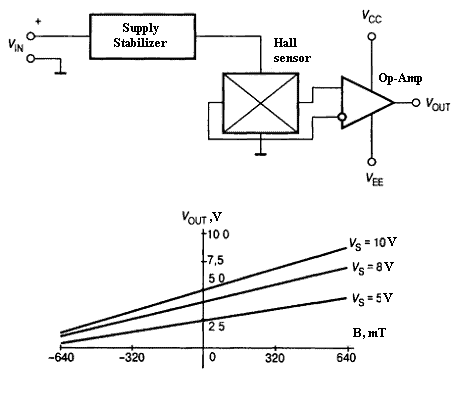
To achieve this differential amplifier has to be used, characteristics will be corrected to be output voltage zero when there is no magnetic field.
Other groups of hall sensors have comparator built-in. This allows having digital level signals on output. There can be two types of such hall devices: switches and triggers.
Unipolar Hall switch
Unipolar Hall switch acts as the unipolar device which is OFF if there is no magnetic field or its direction is opposite, and ON when the magnetic field is present and direction is positive.

Bipolar Hall trigger
Bipolar Hall trigger reacts in both directions of the magnetic field. It switches ON when it reaches a positive or negative magnetic field level and switches off when this field lowers to some value. And of course, there can be many variations on where the threshold is positioned.
For instance, two Hall sensors HAL556 and HAL566 have only two active pins:
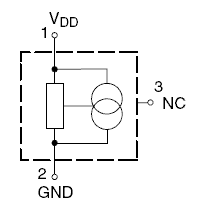
These sensors change power consumption depending on the external magnetic field.
Ok lets see where can be hall sensors used.
Linear Hall sensors
- Current sensors;
- Frequency measuring;
- Control and protection of electrical motors;
- Displacement sensors;
- Consumption measurement;
- Brush-less electrical motor control;
- Non contact potentiometers;
- Angle sensors;
- Vibration sensors;
- Tachometer.
Digital Hall sensors
- Rotation speed measurement;
- Synchronisation devices;
- Car Ignition;
- Displacement sensors;
- Pulse counters;
- Door blocking;
- Brush-less electrical motor control;
- Consumption measurement;
- Non-contact relay;
- Close object detectors;
- Magnetic card readers;
- Paper sensors (printers).
Hall current sensors
As an example – linear hall sensors are used for current measuring from 250mA to thousands of amps.
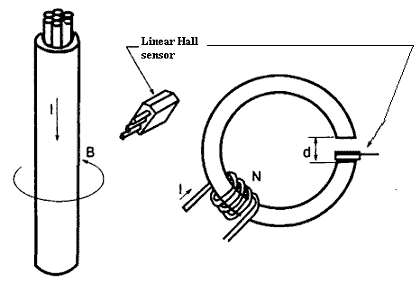
Such measuring devices don’t have to be connected physically to the circuit. This way, you can measure DC and AC currents. According to the picture above- if Hall sensors are very close to the wire with current, then the sensor output voltage will be proportional to magnetic field strength proportional to current which generates this field. The formula can calculate current:
B=1.57·I·N/d
where B – magnetic field strength(T), I – current strength(A), d – gap in concentrator(m), N – number of wire turns.