




Soldering SMD parts isn’t a hard task, and there are many methods of doing this. Let’s go through several SMD soldering methods and examples.
Method 1: using the soldering iron
For this you will need:
- Good sight or magnifying glass. Better one and another;
- Soldering iron with small tip ~10W;
- solder wire with a diameter of about 0.6mm
Steps to follow:
- cut solder wire in pieces in the length of element width:

- Put SMD element on circuit board where it has to be soldered:
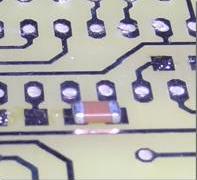
- Put solder wire piece next to SMD:
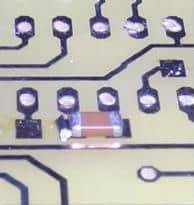
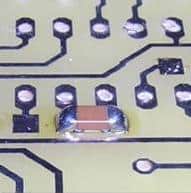
- While holding SMD component with tweezers solder part to the board by applying iron to the solder;
- Once one end is soldered, repeat the same procedure with another end of the SMD element:
Method 2: soldering SMD in the oven
This method is handy when you need to solder SMD packages like LQFP, TQFP64, etc. If you don’t have a special oven for soldering SMD, you can use one you find at home. Of course, take all safety precautions while working with ovens!
For this you will need:
- Mini-oven up to 250ºC. It can be the cheapest oven or grill. Don’t use a microwave!

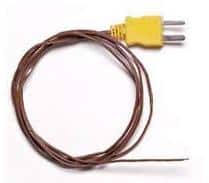
- The thermometer is capable of measuring temperature in the range of 20ºC – 300ºC. A possible solution to use thermocouple and multimeter:
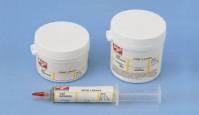
- Soldering paste containing 85% of solder (e.g., Sn62Pb36Ag2) and 15% of flux.
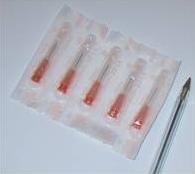
- Injection needles about 1mm diameter:
Soldering requires more skills and the right selection of temperatures. Soldering consists of following stages:
- Heating. Gradually increasing temperature of SMD element and solder;
- Drying. The time when Flux takes action and dries out. Duration about 1min and 30 s;
- Melting. Melting soldering paste and heating to a maximal temperature about +20ºC above melting temperature of paste;
- Cooling.

This characteristics depends on soldering paste used. Look in specifications.
Find out the characteristics of your soldering oven.
- Heat oven up to 125ºC. The curve angle should be 1-4ºC/min;
- Leave 125ºC for 1 min and 30s;
- Turn on the oven and reach 210ºC;
- Turn off the oven and open the door.
Read characteristic with thermocouple and then construct a chart like this:
Then you can make some conclusions from this chart:
- Heating speed. Lower speed than recommended is OK ;
- The drying stage isn’t stable – if the temperature drops too fast, add little heat to keep the temperature at the level. Or maybe the oven has automatic heat regulation.
- The melting phase is OK;
- Cooling. A smooth drop in temperature is better. Don’t try to take the circuit board too fast as solder may still be soft, and SMD elements may move. Leave to cool down up to 80ºC; then, you can take the board off.
Testing oven soldering method
Put some soldering paste on the circuit board, counting that paste loses about 1/3 of its volume. If applied too much, you may get soldering bridges between legs; if not enough, few of the leads may stay un-soldered.

When the paste is applied – place the SMD component in its place and put the Circuit board to the center of the oven. The temperature sensor should be close to the board:

Then set Oven to 250ºC and wait until the temperature reaches 125ºC, then turn it off for 1min and 30s. Then turn the oven and reach 210ºC. You should see-through window of how soldering paste melts and forms a drop which fixes legs SMD elements. When 210ºC is reached – process over. Turn off the oven and open the door:
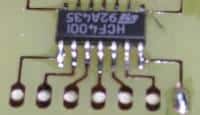
After cooled – test if all contacts are well soldered.
Remember that:
- Hot air in oven oxides tracks. So after oven soldering, usual soldering may be harder. One way is to clean tracks from oxide;
- Melting flux produces flammable gasses that flames at 100ºC. Don’t smoke while opening the door of the oven;
- Soldering paste is dangerous. Ventilate the area where you are working.
Sources: www.radiokot.ru, https://cxem.net.
Excellent article.
The idea of using a owen to solder SMD is fantastic. I’ll look for a old one right now !!
Greetings from Spain
I wonder one thing, will the IC and other SMD elements survive in the oven at that temperature? Most semiconductors break down at that temperature, aren’t they?