




Among the usual antennas used in today’s data transfer, different types of antennas are used. First publications about electrodynamic characteristics of fractal structures were published in the 1980s, but the first practical approach appeared after 10 years. Dr. Nathan Cohen, professor of Boston University, designed, engineered, and patented many practical fractal antenna solutions and founded “Fractal Antenna Systems” in 1995.
Van Koch fractal antenna
As Nathan states, there were forbidden to use external antennas in the city in the center of Boston. Hence, he managed to hide the antenna within the design of an amateur radio station. He took aluminum foil and made an antenna as decoration according to Van Koch figure:
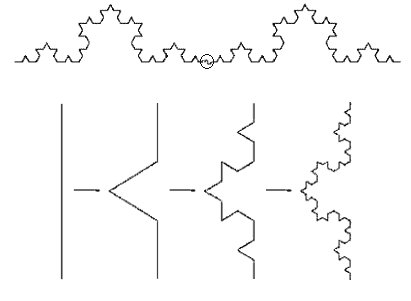
This figure builds as follows: first-line (length is z)is cut in 3 even pieces z/3. In the middle, the triangle is formed with the same side lengths z/3 and same angles. This way wee gets a single element template. Then repeat this process with other segments where sizes diminish 3 times (z/9), then follow 3 times (z/27) again, and so on. This way, fractal size doesn’t change.
Recursive tree fractal antenna
Today fractal antenna technology is in the early stages because engineers are doing empirical experiments to find out what geometrical structures give better results. During these experiments, they found out that using ordinary type antenna templates building fractals gives a better gain coefficient. Like this antenna type:
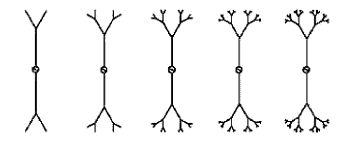
This type of structure is a so-called recursive tree. Each new iteration multiplies branches by two and lowers resonance frequency. So using iterations, it is possible to use the antenna at lower frequencies without increasing antenna size.
Dipole antennas usually have a narrow band-about 2.4% around frequency carrier. If the 5th iteration is used, then this parameter grows up to 3.1%. If the 3D tree is used (when there are 4 branches used instead of 2), this parameter grows up to 12.7%.
Loop Koch figures
Besides Dipole antennas there are resonant loop antennas used. Loop antennas are build using Koch figures:
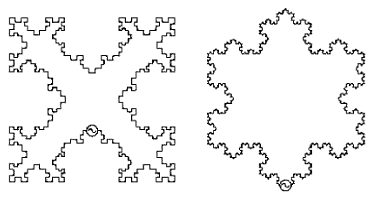
Ordinary frame antennas have low input impedance what makes it difficult to connect to the feeder. Fractal loops allow increasing impedance even for frequencies lower resonance, and this way, effectiveness increases.
Another thing that makes fractal antennas so attractive is that they can be fabricated using PCB making methods. Because of the compact size, they can be put directly on PCB inside like a cell phone.
Sierpinski fractal antennas
Additionally to narrowband antennas, there one type of antennas – wide band. These are Sierpinski antennas are frequency independent and have several resonance bands, and can be compared to log-periodic and spirals. Frequency independence is a result of retaining a similar shape at many scales. Sierpinski fractals don’t require additional space while frequency band grows as it happens with spiral and log-periodic antennas:
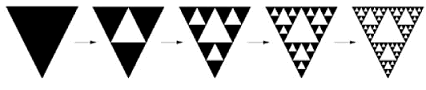
Sierpinski fractal antennas can be successfully used in automotive where transparent antennas are stuck to the front window (or other) and can receive multiple bands independently to standard and country.

Another widely used example is cell phones. They are a long time using internal fractal antennas:

This allows using multiple bands like 900MHz, 1800MHz, 1900MHz, and so on.
Source: RA-2002-09
Meesage from Jyoti Joshi by email:
I am student of Karlsruhe University, Germany. Currently I am experimenting on Sierpinski Fractal Antennas for 200 MHz to 900 Mhz range.
Has anybody tried Sierpinski Fractal in this range ?
Can you share your experiences, suggestions ?
Regards
I am interested in building a fractal antenna which would be omnidirectional with a bandwidth from 27 MHz through to 3 GHz… Has anyone experimented along these lines? If so, can they share their experiences so that we neophytes may learn? Thanks.
can you please provide me with some more material on Fractal Slot Antennas. Actually i am a student of M.Tech at IIT Roorkee and will be doing my thesis on Fractal Slot Antennas.
this is a very good site for info on fractal antennas. 21 different designs were made in a seven month period, and the fra 1a is the best of the best.
churka
Interesting question, Britt… did you ever hear from anyone or learn anything anyhwere else about building an omnidirectional antenna with bandwidth from 27 MHz to 3GHz?
@Churka,
Where did you see 21 different fractal antenna designs?