Archive for the 'Electronics' Category

Consider PWM signal

Tuesday, May 16th, 2006

When using microcontroller and want to drive motor control or control led intensity you can use DAC to generate analog output voltage. But there is an easier way of doing this. You can use digital output to reach same results. This technique is known as PWM – Pulse Width Modulation.

In this picture you can see [...]

K-Type Thermocouples reviewed

Thursday, May 11th, 2006

A thermocouple is a sensor that generates an electrical potential related to the temperature. The operating principle of the sensor is base on the fact that any electrical junction between two different metals generates an electrical potential that depends on the temperature and the metals that are used. The principle applies equally well if three [...]

Impulse signal distortion in transmission line

Tuesday, May 9th, 2006

Today most electronic equipment consists of signal generators and processing units. These units are connected with transmission lines. These lines have big influence in signal distortions. On these lines depends transmition lines stability. Let’s see how transmition lines affect transmitted signals.

(G- signal generator; Za- output impedance; I- signal receiver Zb- input impedance; [...]

Flash vs. EEPROM

Tuesday, May 9th, 2006

There are many questions about Flash and EEPTOM differences. Well these are two different technologies converging together.
Flash technology was created to replace mass storage media. Requirements for Flash were minimum power consumption and high number of write cycles. Information written in flash memory is usually in blocks at a time.
EEPROM was originally designed to store [...]

Filter output dependency on tolerance of elements

Monday, May 1st, 2006

Sometimes we need to project simple filter with particular characteristics. We usually take calculations with ideal parameters and don’t look on tolerances of them. Let us see how simple filter output depends on its elements tolerances.
For this let’s choose simple filter circuit:

We are going to calculate filter response characteristics. The band pass frequency is taken [...]

Z axis accelerometer MMA1220D from Freescale

Thursday, April 27th, 2006

MMA1220D is Z axis MEMS accelerometer -8g - +8g. This sensor has capacitive sensor. The output signal is passed through 4 pole low pass filter. It also has internal self test capability. The main features:
Integral signal conditioning;
Linear output;
Ratio metric performance;
4th order Bessel Filter to preserve pulse shape integrity;
Calibrated self test;
Detection of low voltage also clock [...]

Emergency supply source for your electronic device

Thursday, April 13th, 2006

Sometimes you are needed to maintain power supply for your device for some time when the main source fails. It can be alarm system or some light source or digital clock. Of course if source interrupts are very short, there can be capacitor with big capacity connected, but it is not reliable. Better use backup [...]

Physiological system modeling

Wednesday, April 12th, 2006

Most of physical and chemical experiments can be described with a finite number of rules. In physiological processes everything can be tied to laws of nature. Good model can be as a guideline to new experiments. Usually model and experiment has iterative connection. In order to understand ho to investigate any material there is model [...]

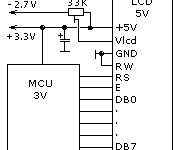
CMOS and TTL compliance

Wednesday, April 12th, 2006

There was a time, when all IC’s were only TTL type. They were marked as 74LS or 74ALS. But then there came CMOS types of semiconductor. They are usually marked CDxx. And lately there appeared combined semiconductors who are compliant to both types. They usually are marked as 74HC or 74HCT.
TTL are faster than CMOS, [...]

Polarizer test

Sunday, April 2nd, 2006

I used simple lamp directed to glossy table surface. One polarizer is in front of lamp and other is in front of lens of digital camera. Both polarizes are perpendicularly oriented to each other. How does this work? There is a theory about an angle on which the incident polarized electromagnetic waves turn reflects from [...]