DIY simple band-pass filter

This filter was designed to filter the 1kHz frequency of the telemetric signal from environmental noise. The filter itself is straightforwardly built with acceptable electronic parts worldwide. This filter can be used in any circuit because of its simplicity. The circuit contains a minimal amount of parts, including one general-purpose NPN transistor with coefficient 50…70 and more. Such filter blocks may be connected in series directly one to another(second IN first OUT). This way, filter gain may increase up to 1,2…2.

Continue reading

Testing AVR universal bootloader on Atmega128

After the project source code is developed, there is always a need to flash it to the microcontroller. There are a few ways to program AVR microcontrollers. Usually, we used to flash AVR’s with an ISP adapter (or another programmer) that is not always handy, especially when designing a device for the end-user who doesn’t have an ISP adapter or doesn’t know much about flashing MCU. So it is better to flash a bootloader program AVR MCU once with a programming adapter and later load firmware interactively when starting AVR. The bootloader allows updating the firmware without a programmer and enables different programs for different purposes depending on the situation flexibly. But enough about this. So my purpose today is to test AVR universal bootloader, which Shaoziyang is developing. He aimed to create a universal bootloader that works on different AVR microcontrollers with minimal code modifications. Bootloaders you can find on the Internet are mostly available for particular microcontrollers, and nobody wants to do a lot of modifications to adapt to different MCU when needed. This AVR universal bootloader can support most AVR microcontrollers (Mega series), which have the self-programmable capability, boot section, and UART. If the device has many…

Continue reading

Easy way to measure motor torque

Motor torque (momentum) is one of the motor ratings used to indicate the rotary motor force produced on its output shaft. The motor torque rating is usually captured at the point when the motor is stalled. The torque measurement unit is (Nm) in the metric system or (ft-lbs) in the US system. But the principle is the same torque is a multiplication of lever length (r) and force(F) applied to lever: I=r x F So there is a simple experiment on how to measure motor torque quite accurately without any fancy measuring tools. All you need is a motor of which torque will be measured, a nominal power supply of motor, thread long enough, a mass of known weight, ruler, and a table or other lifted surface where the motor will be fixed.

Continue reading

Testing pulse transformer with an oscilloscope

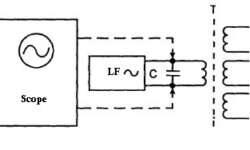
Pulse transformers are a little different from regular AC transformers. In AC transformers, magnetic flux alternates between negative and positive values in the core, while in pulse transformers, magnetic flux is unipolar. Pulse transformers are used in TV, computer power supplies. If you need to test a pulse transformer, it may be almost impossible to do this with an ohmmeter, even a digital one, because the windings of impulse transformers have meager active resistance except for high voltage ones. One way to test is to measure the inductance of windings and compare them to values in specifications. Still, not everyone has the ability to measure inductance, and not always you have transformed specifications near by. So there is another way to test pulse transformers, which may be acceptable to almost everyone radio-hobbyist, using a low-frequency generator that works at the resonance frequency of contour, which consists of external capacitor and pulse transformer winding.

Continue reading