Archive for January, 2007

Calibration and monitoring sensors

Thursday, January 25th, 2007

Every sensor that measure real world things have real tolerances. There is no absolut accurate sensors as there are many factors that influence tolerances and reliability. If you ever tried to measure simple resistor resistance you noticed that 1kΩ resistor actually is between 990Ω to 1,1kΩ. This means that tolerance of resistor is 1%. if [...]

Electric circuits analogy to water pipes
Monday, January 22nd, 2007

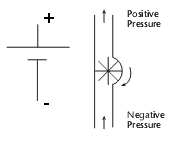
Sometimes calculating parameters and behaviour of some objects may be much easier when using analogy to objects with well developed theory and calculation methodology. In earlier article we analysed power dissipation of electronic devices using Ohms law where Voltage=temperature, Current=Dissipation and Resistance=Thermal resistance. This time lets look how can electronic devices transformed in water [...]

Thermal analysis of semiconductor devices-when do you need heat-sinks

Monday, January 22nd, 2007

Every electronics constructor and engineer knows that electronic devices like IC’s voltage regulators and CPU heats up. Temperature is critical parameter for reliable system operation. System reliability is very closely related to device temperature high or low. While temperature increases the reliability drops exponentially. If you look in device datasheets you will find a [...]

MCU performance metrics

Wednesday, January 17th, 2007

We always want to compare different types of MCU. If we look at PC processor industry it is becoming almost impossible tas objectively to compare two different processors as they are different in design and even have different number of cores.
But lets go through few characteristics that are used for comparing different embedded [...]

Fault tolerance of embedded systems

Wednesday, January 17th, 2007

Fault tolerance is one of major requirements for Embedded systems. As the embedded systems become more complex, there is more chances for various failures. Somehow when designing Embedded system developer has to deal with these faults. Before dealing with faults designer has to identify and understand the types and nature of faults.
Faults can be hardware [...]

PCB construction methods for embedded controllers

Wednesday, January 17th, 2007

The most common method is of constructing embedded controller systems is a Printed Circuit Board (PCB). I think all electronics know, that simple PCB is constructed of insulating material like epoxy impregnated glass cloth with a thin copper sheet(s) on one or both sides.
There are many conflicts about requirements on how to design [...]

Schmitt trigger VS simple inverter

Tuesday, January 16th, 2007

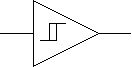
Schmitt trigger is special logical element adjusted to work with analog input signals. The primary purpose of Schmitt triggers were restoring the shape of digital signals. Because of transmission line effect digital shape transforms from square to trapezoid or triangle or more complex signal. Of course during transmission signals become noisy and [...]

Marking of Digital IC chips

Monday, January 15th, 2007

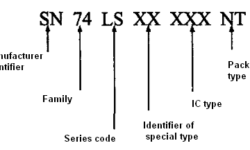
Currently there are huge amounts of different digital IC chips available in the market starting from simplest logical elements and ending with processors and gate arrays (FPGA). Of course there also are lots of IC manufacturers offering IC’s. Many of them are specialized and wont be reviewed here. Lets limit ourself to smaller more general [...]

VGA to X-Y-Z scope converter

Friday, January 12th, 2007

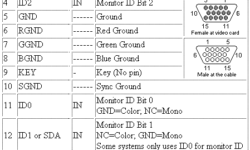
This is fun project I found on Jon’s antique radios web-page. He has managed to convert VGA output signal from PC to X Y X oscilloscope signal. Converting VGA RGB signal to synchronized oscilloscope input signal is pretty easy because VGA has two sync signals separate from RGB signals. Look at pin-out of VGA cable:

Sync [...]

ATTiny2313 Monitor tester

Friday, January 12th, 2007

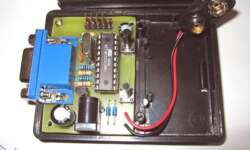
This project was born for repairing broken PC monitors. This allows to avoid using a computer while testing monitor patterns. The Tiny monitor tester uses ATTiny2313 AVR MCU running at 20MHz speed. Such speed allows running synchro H and V signals directly form MCU ports. Also circuit converts R,G,B signals to analog using simple R-2R [...]