Archive for November, 2006

KontrollerLab IDE development software for AVR under Linux

Wednesday, November 29th, 2006

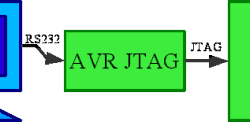
Good news for Linux lovers. The new IDE development software for AVR microcontrollers has shown up. This is KDE based IDE under GPL. It is fully-featured editor which includes serial terminal for debugging, uses AVR-GCC compiler, uisp for serial downloading and avrdude programming software.

Few screen-shots of this tool:

Main project window

Fuse settings window

Project configuration window

Compiller  settinds

Programmer [...]

Connect Nokia 3310 LCD to LPT port

Wednesday, November 22nd, 2006

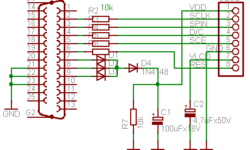
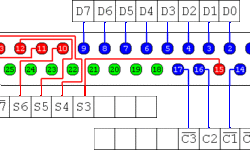
I found this circuit really simple and interesting. It is really simple to drive Nokia 3310 graphical LCD by using simple LPT cable and some PC software. Firs of all connect graphical LCD to LPT port according to following circuit:

Graphical display needs about 3.3V of supply voltage, while LPT gives about 4.5 -5V. This is [...]

High capacity multimedia cards in embedded systems

Wednesday, November 22nd, 2006

Multimedia cards are popular around us. There are well known Compact Flash, CD, MMC Memory Stick. Usually when you make new design with external memory you usually are considering EEPROM or Flash ICs with some capacities with up to few Mb. But why limit yourself, because in some cases it is smarter to add multimedia [...]

RS-485 interface for connecting multiple devices

Monday, November 20th, 2006

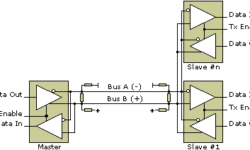
RS-485 is updated version of RS-422 interface. It is designed to communicate between multiple devices connected to single data line. Standard allow connecting 32 transceivers to data line. This is achieved by using tri-stable drivers that are separate programmable. This allows only one device work at a given time.

Resistors used in circuit are so called [...]

RS-422 interface basics

Monday, November 20th, 2006

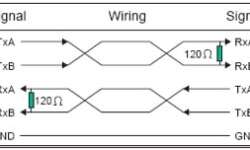
RS-422 is a standard for serial data transfer similar to RS-232, but it uses difference between two lines (RS-232 uses reference to ground). RS-422 uses twisted pair (difference pair) to represent logic level. Such data transmission type is so called balanced transmission as it is not referenced to ground. This is noise proof solution because [...]

ATMEL announced 3 new low power Tiny AVR microcontrollers with high speed timers

Friday, November 17th, 2006

Atmel’s new devices are 20-pin tiny-AVR microcontrollers with high-speed timers.
All three devices are pin-compatible, differing only in the size Flash, EEPROM and SRAM memories.

The ATtiny261 has 2 Kbytes of self-programmable Flash memory;
The ATtiny461 has 4 Kbytes of self-programmable Flash memory;
The ATtiny861 has 8 Kbytes of self-programmable Flash memory.

All devices deliver 20 MIPS throughput when running [...]

Dealing with switch bounce problem

Tuesday, November 7th, 2006

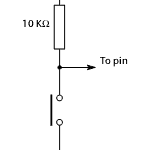
Normally any embedded system has a relations with real word. Simplest and most common way is using buttons.

This is how application interact with human. But real world like a human is not perfect. Practically mechanical contacts bounce (turns on and off repeatedly for a short period). And you cannot do anything about it. And for [...]

Oscillator frequency and code speed

Tuesday, November 7th, 2006

One of important questions you ask when considering microcontroller project is wat oscillator frequency to choose. Usually it depend desired level of performance. In general application speed is directly determined by oscillator frequency. If you double the oscillator frequency, the application will rin in double speed.
But wee do not compare different processors by frequency, but [...]

Use neural sensors to build smart sensor systems using microcontrollers

Monday, November 6th, 2006

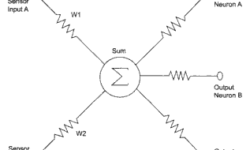
Neural networks are wide topic. But this small example demonstrates how to create basic neural sensor which takes resistive readings from multiply sensors and multiply it by wight factor and then sum the results. Results are compared to three level threshold. Without going too deep in to neural networks we can say, that neural cell [...]

Sample routine of working with LPT1 port under windows XP in CPP language

Friday, November 3rd, 2006

This is simple routine of sending and reading of byte from LPT1 port under Windows XP.
LPT port has four types of pins:

8 output pins accessed via the DATA Port
5 input pins (one inverted) accessed via the STATUS Port
4 output pins (three inverted) accessed via the CONTROL Port
The remaining 8 pins are grounded

Now we are interested [...]